OpenAI-compatible · 417 models

One endpoint.
Every model.

InferMux multiplexes the model routers. Point any OpenAI client at one base URL and get the whole catalogue — plus ordered collections that fail over on their own, scoped keys, per-token metering, and a coding agent that runs on our servers and executes on your machine.

417
models
53
vendors
2M
max context
21
free models
curl https://infermux.net/api/v1/chat/completions \
  -H "Authorization: Bearer $INFERMUX_KEY" \
  -H "Content-Type: application/json" \
  -d '{
    "model": "collection/frontier",
    "messages": [{"role": "user", "content": "Ship it."}]
  }'
Drop-in OpenAI base URL — no SDK to swap, no prompt to rewrite.
Auto-route
Scoped keys
Metered

Every vendor in the catalogue · refreshed every 3 hours

OpenAIQwenGoogleAnthropicMistralZ.aiDeepSeekMiniMaxNVIDIAMoonshotMetaxAITencentByteDanceThinking MachinesCohereAmazonPerplexityOpenAIQwenGoogleAnthropicMistralZ.aiDeepSeekMiniMaxNVIDIAMoonshotMetaxAITencentByteDanceThinking MachinesCohereAmazonPerplexity
The platform

A router of routers, with the boring parts done

Everything you would otherwise build twice: fallback, scoping, metering, billing and a catalogue that stays current on its own.

Collections that route themselves

Group models into an ordered collection and call it as collection/your-slug. The order is the routing order: on a failure, a rate limit or an unaffordable model, InferMux falls through to the next member and records every attempt.
Two-stage vision routing

Send an image to a mixed collection and the picture goes to the first vision-capable member; its answer is folded back in as a system note and handed to your text model. One request, two specialists.

Scoped keys, minted to spec

sk_mr_ keys carry their own model list, collection list, expiry and hard spend cap. Looked up by SHA-256 digest, so auth is O(1) — revoke, expire or cap without touching your account key.

Prepaid credits, honest ledger

Every upstream attempt writes a row — successes and failures. Charges use the cost the provider actually reported, so your ledger reconciles line by line instead of by estimate.

UTC-aligned allowances

Subscription allowances count against hour, day and week windows aligned to UTC, not rolling ones — so every reset point is a real instant the API can tell you in advance.

Drop-in login widget

Paste one script tag and your users sign in to mint a scoped, expiring key in their own account. You get BYO-LLM economics without ever holding a password.

Usage you can actually read

Tokens in and out, spend, error rate and every routing attempt — sliced by hour, day, week, month, year and all-time, per key and per model.

Tool-aware planning

Requests carrying tools narrow the candidate list to tool-capable models automatically — 348 of them in the catalogue right now.

Auto-route

Failover that shows its work

Every response carries a router block naming what actually ran: what you asked for, what answered, how many attempts it took and what you were charged. Streaming responses end with the same summary frame.

  • 1

    Plan

    The request is scoped against your key, priced against the mirrored catalogue and turned into an ordered candidate list.

  • 2

    Route

    Candidates are called in order. Failures, rate limits and unaffordable models fall through — each attempt lands in the ledger.

  • 3

    Meter

    The winning attempt is charged at upstream cost plus markup, or covered by your subscription allowance if the plan includes it.

250 vision models and 314 reasoning models are eligible for staged routing today.

POST /api/v1/chat/completionsauto_route
"model": "collection/frontier"
  • 1deepseek/deepseek-v4-flash-vision-exp
  • 2qwen/qwen3.8-27b
  • 3google/gemini-3.7-flash
attempts2resolvedqwen/qwen3.8-27bcharged$0.0021
Inside the product

Not a landing page promise — the actual app

Every screenshot below is a live capture of the running console: the catalogue, collections, the playground, usage, credits and Dave.

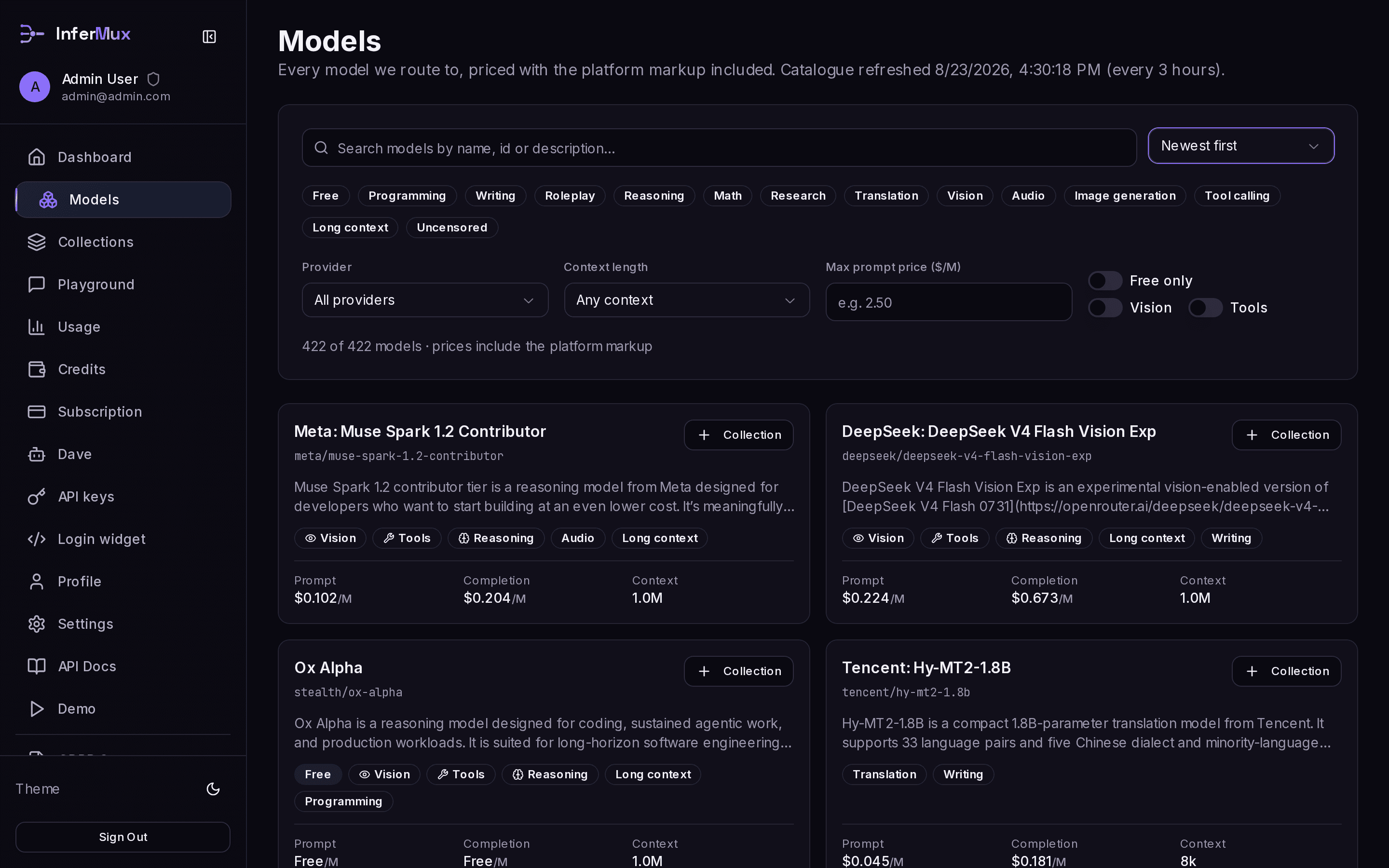
infermux.net/dashboard/models
Every model, priced and filterable
Every model, priced and filterableThe mirrored catalogue with derived capability tags, context length and your real per-million price — markup already applied.
dave — connectedws /api/v1/dave/ws
$ dave
 paired with infermux.net
 sandbox: ~/work/api (read/write)

you ▸ find why the webhook retries twice
  ◦ grep "retry" src/**   (local)
  ◦ read src/webhooks/deliver.ts (local)
  ◦ edit src/webhooks/deliver.ts (local, approved)
dave ▸ the ack was written after the enqueue —
        moved it inside the transaction.

metered as source=dave · covered by plan
What a subscription buys

Meet Dave, the hosted coding agent

A full agent loop you do not have to host, wired to a client that keeps execution — and your source — on your own machine.

  • The agent loop runs on our servers; every tool call runs on your machine over one authenticated WebSocket.
  • Nothing executes server-side — the client owns the sandbox and the permission policy.
  • Model calls come back through the router, so a session is metered and billed like any other traffic.
  • Ships as a small Bun binary for macOS, Linux and Windows.
Get Dave
Pricing

Upstream price, plus 2%

No seat fees, no minimums, no per-model negotiation. You pay what the provider charges plus a flat markup — visible on every model card and every ledger line.

Pay as you go

$3.00$3.06/ million tokens

Prices are stored as the upstream decimal strings, verbatim, and the markup is applied on read — so nothing is rounded away between what the provider charged and what you are billed. Free models stay free: 21 of them consult neither credits nor allowance.

Prepaid creditsPer-key spend capsFull ledger exportNo expiry

Subscription

Allowance tiers

Token allowances per hour, day and week that cover Dave — and, when the plan allows it, your direct API calls too. Windows reset on UTC boundaries you can predict.

See the tiers

Swap one base URL. Keep every model.

Create an account, mint a scoped key and point your existing OpenAI client athttps://infermux.net/api/v1. That is the whole migration.

InferMux — one endpoint, every model